Introduction
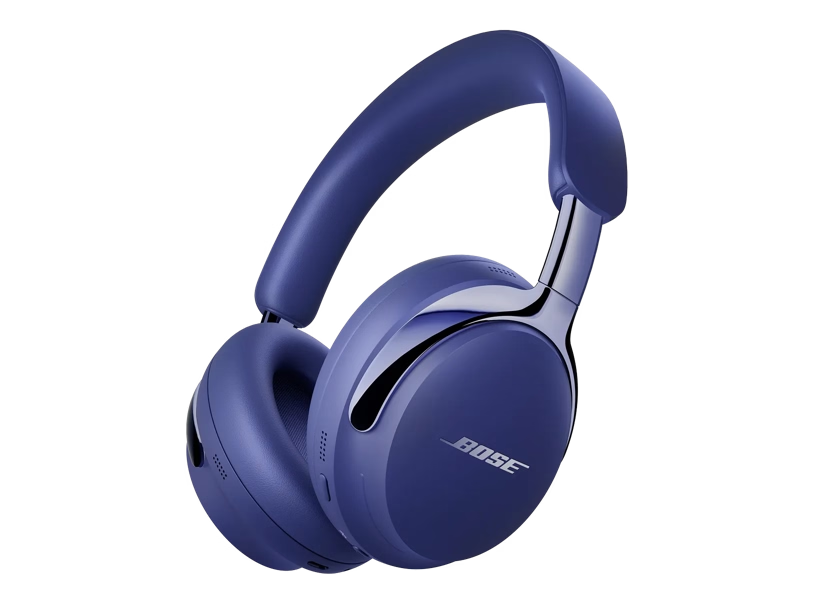
The Bose QuietComfort Ultra Headphones 2nd Gen are not trying to reinvent Bose’s formula. They are trying to sharpen it. Bose keeps the premium comfort-first design, strong ANC, the warm sound profile, and the easygoing usability that made the QuietComfort line popular in the first place. Upgrades and features include CustomTune premium sound, high-quality noise cancellation, 30 hours of playtime with ANC on, immersive audio, clearer phone calls, the Bose app, Bluetooth multipoint, customizable shortcut control and support for connecting to an airline entertainment system. You also get a premium accessory package: a zippered carry case, 3.5 to 2.5mm audio cable, USB-C to USB-C cable, safety sheet, and cushions already connected to the headphones.
Active Noise Cancellation:
Bose’s active noise cancellation is its specialty. According to expert reviews, they describe the noise cancellation as excellent, with some arguing it’s best-in-class. RTINGS, for example, notes overall ANC attenuation of -26.4DB, which means reducing outside noise before the music starts playing, things like engine rumble, airplane noise and background noise. With that being said, it is safe to say Bose is quietly following the “Don’t fix what’s not broken ” strategy. Improvement from QC Ultra Gen 1 is only marginal. SoundGuys notes the ANC improvement is small, while Headphones.com says attenuation is more-or-less the same. The only thing worth noting is Gen 2’s ability to deafen sudden, unpredictable noise, thanks to its AI-powered microphones. What matters is the overall consensus of the ANC, which is considered excellent by both experts and consumers.
Microphones and Calls:
The microphone and call quality are considered “very good”. Bose highlights clearer phone calls as one of the key upgrades, and an improved microphone system with 10 microphones, AI-powered background noise reduction, and stronger voice pickup. In simple terms, the headphones are not just trying to block noise for you; they are also trying to make sure the person on the other end can hear you clearly.
That matters because call quality is one of the hidden dealbreakers with premium wireless headphones. A pair of headphones can sound amazing for music, but if your voice sounds distant, muffled, or buried under background noise during calls, they become much less useful for work and daily life. The QuietComfort Ultra 2nd Gen solves this problem better than many competitors, with user feedback pointing towards reliable call performance.
For remote/office workers, this makes the Bose feel more complete as an all-purpose headphone. The upgraded mic system should help your voice come through clearly, while the background noise reduction helps reduce distractions from office chatter, keyboard noise, traffic, or general room noise. That means you can take a call in more places without immediately sounding like you are in the middle of a busy environment.
There is still one caveat: tougher conditions can still expose the limits of wireless headphone microphones. Wind, heavy street noise, loud cafés, or sudden background sounds may still affect call quality. AI noise reduction can help, but it cannot perform miracles in every environment. So while the QuietComfort Ultra 2nd Gen looks like a very strong choice for calls, it is still not the same as using a dedicated headset microphone in extreme conditions.
Overall, call quality is a clear strength. If you want headphones that can handle music, noise cancellation, office meetings, and phone calls without constantly switching devices, the Bose QuietComfort Ultra 2nd Gen makes a strong case for itself. They are especially appealing for remote/office workers, commuters, students, and anyone who uses their headphones as both an entertainment device and a daily communication tool.
Sound Quality:
The Bose QuietComfort Ultra Gen 2 has a warm, bass-boosted sound, which means it adds extra weight and richness to the low-end of your music. SoundGuys describes the bass as sitting roughly 3-6dB above neutral, so the bass is noticeably stronger than a perfectly flat reference sound, but not so extreme that it overwhelms. For the average listener, this means kick drums hit with a bigger punch, bass guitars feel thicker and pop, hip-hop, EDM, R&B and movie soundtracks sound more surreal. A good treble also matters. Bose has not made the headphones dark and muddy, full of bass. Higher frequency details like vocals, cymbals, and small background noise still add to the richness of Bose’s signature sound, making the sound feel like it’s playing right in front of you. So the overall tuning from the box is consumer-friendly: rich, smooth and powerful with enough detail to make it feel lively.
The Bose QC Ultra Gen 2 shouldn’t be viewed as a strict audiophile reference headphone. It’s more of a premium device that you can enjoy right out of the box. Warm, seamless and compatible for everyday listening. A standout feature is its CustomTune, which sends a brief frequency to scan the anatomy of your ear so it can customize ANC configuration and EQ unique to your ear.
The contradiction is that the sound is widely praised, but not ideal for sound purists and audiophiles. With its limited EQ customization app, Bose only offers a 3-band EQ (bass, mid and treble), instead of a more detailed 5-band or 10-band equalizer, meaning users have less control over fine-tuning the sound that they want. So if you want clean, fun but premium pair of headphones that deliver strongly on sound quality, the Bose QC Ultra Gen 2 delivers. But if you want a pair of headphones that is optimized for detailed fine-tuning, check out our review of the Sony WH-1000XM6.
Comfort:
The QuietComfort earns the “comfort” in its name. Comfort is one of the biggest reasons people keep coming back, and the QuietComfort Ultra 2nd Gen continues that reputation. These are the kind of headphones you can put on and immediately understand why Bose has owned the “comfort” category for so long. The design is lightweight, the earcups are soft, and the clamping force is gentle enough that the headphones do not feel like they are squeezing your head just to stay in place.
At around 250 grams, they are also lighter than many premium noise-cancelling headphones, such as the Sennheiser Momentum 4 (293 grams) and the Apple AirPods Max 2 at a hefty 382 grams. A headphone can have amazing sound and world-class ANC, but if it feels heavy after 45 minutes of playtime, it becomes a dumbbell instead of something you actually want to wear. The QuietComfort Ultra Gen 2 avoids that problem for most people. They are ideal for long playtime durations with minimal amount of fatigue, and can be used ideally for flights, commuting, studying or long listening sessions.
The padding also plays a big role. The ear cushions have that soft, pillowy Bose feel, so the headphones rest around the ears rather than aggressively pressing into them. This makes them especially appealing for people who hate tight, clampy headphones. Compared with some rivals that feel more structured or heavier on the head, Bose leans into a softer, more relaxed fit.
That said, comfort is not perfect for everyone. The same sealed earcup design that helps with noise cancellation can also trap warmth over time. After a few hours, some users may notice heat buildup around the ears, especially in warmer rooms. This does not mean the headphones are uncomfortable by default, but it does mean they are not magically immune to the usual over-ear headphone problem: closed-back ANC headphones can get warm.
Overall, comfort is still one of the QuietComfort Ultra 2nd Gen’s strongest advantages, if not the strongest. If your priority is a headphone that feels light, soft, and easy to wear for hours, Bose remains one of the safest choices in the premium ANC category. Just keep in mind that during very long sessions, especially in warm conditions, heat buildup may be the one thing that breaks the spell.
Connectivity and Controls:
Connectivity is one of the areas where the Bose QuietComfort Ultra Gen 2 is adequate. The headphones support Bluetooth 5.4, Bluetooth multipoint, USB-C audio, and analog audio, which gives them more flexibility than older wireless headphones that depend almost entirely on Bluetooth. In everyday terms, this means you can use them wirelessly with your phone, connect to two devices at once, plug in over USB-C, or fall back on a traditional wired connection when needed.
Bluetooth multipoint is especially useful for people who move between devices throughout the day. For example, you can stay connected to your laptop for a Teams or Zoom meeting while also keeping your phone connected for calls or music. You do not have to constantly disconnect from one device and reconnect to another. For remote workers, students, commuters, and office users, that kind of convenience can matter just as much as sound quality.
The codec support is also worth explaining. It handles SBC and aptX Adaptive support, with Snapdragon Sound benefits on compatible Android phones. SBC is the basic Bluetooth codec that works across almost everything. AptX Adaptive is the more advanced option, designed to offer better wireless sound quality and lower latency when your phone supports it. In simple terms, Android users with compatible Snapdragon Sound devices may get a slightly better Bluetooth experience, especially for sound quality, video watching, and connection stability.
iPhone users, however, do not get the same benefit from aptX Adaptive. Apple devices generally rely on AAC rather than aptX, so an iPhone user can still enjoy the Bose headphones, but they are not getting the full “higher-quality Bluetooth codec” advantage that some Android users may get. This does not make the headphones bad for iPhone owners, but it does mean the spec sheet looks more compatible with Android users than it does for Apple users.
The inclusion of USB-C audio is a nice upgrade because it gives users another way to listen without relying on Bluetooth. This can be useful if the battery is low, if you want a more stable connection, or if you are using the headphones with a laptop. Analog audio is also useful for older devices, airplane entertainment systems, or situations where Bluetooth is not available. Bose is clearly trying to make these headphones work across more situations, not just one perfect wireless setup.
Controls are where the experience becomes more mixed. On paper, Bose gives you shortcut controls, app customization, and touch-based adjustments, which sounds premium. In real life, though, several users suggest the controls can be a little fussy. Some Amazon users complain that the touch controls are too sensitive or unreliable, while others mention issues with the multifunction Bluetooth/power button, the volume slider, and occasional random connection problems.
The volume slider seems to be one of the more polarizing parts. Touch-based volume control can feel sleek when it works properly, but it can also become annoying if small gestures cause bigger changes than intended. Chad said he prefers a physical button; a touch slider gives you a more modern feel, but also more room for accidental inputs. That is the tradeoff Bose appears to be making here.
The multifunction Bluetooth and power button is another area where simplicity can become a problem. When one button handles multiple jobs, it can sometimes feel less intuitive than having separate dedicated controls. For some users, this will be fine after a short adjustment period. For others, especially people who prefer simple physical buttons, the control layout may feel less polished than the rest of the headphone experience.
Overall, the QuietComfort Ultra Gen 2 has a premium connectivity package, but the controls may not feel equally premium for everyone. The headphones give you Bluetooth 5.4, multipoint, USB-C audio, analog audio, and better codec support for compatible Android devices, which is excellent on paper. The weaker point is the daily interaction: touch sensitivity, button behaviour, and occasional connection quirks may frustrate users who want everything to feel effortless. So the features are strong, but it’s up to you how you feel about it.
Battery Life:
Battery life is solid, but not class-leading. Bose says it can last up to 30 hours of playtime, while Hi-Fi.com says you can play up to 45 hours with ANC off, 30 hours with ANC on, and 23 hours with Immersive Audio enabled. That is more than enough to cover a flight, a commute, and several days of normal listening before needing to juice up again.
Charging time is its strong point. Although it takes three hours to charge to 100%, many Amazon users report that a quick charge of 15 minutes can last 2 hours of use. You can also listen through the USB-C audio while charging at the same time, which adds convenience. Some competitors do offer longer playback, such as the Dyson OnTrac, which offers up to 55 hours of playtime with ANC on. For more information on the Dyson OnTrac, check out what we think of it here. Overall, we would consider the battery to be “good enough” for the premium overhead headphone market.
Listening Modes:
The Bose QuietComfort Ultra 2nd Gen gives you several listening modes depending on how isolated or aware you want to be. The main ones offered are Quiet Mode, Aware Mode, Immersive Audio, and the all-new Cinema Mode.
Quiet Mode is the full noise-cancelling experience. This is the mode you use when you want to block out office noise, traffic, airplane rumble, or general background distractions. Consumers and experts generally agree that Bose’s quiet mode is sublime and is excellent at blocking external noise.
Aware Mode lets outside sound in, but still tries to keep loud noises under control. Aware Mode uses microphones to hear the world around you while blunting louder sounds, so it is useful when walking outside, talking briefly, or staying alert without fully removing the headphones.
Immersive Audio is Bose’s spatial audio feature. It makes music feel wider and more open, almost like the sound is coming from around you rather than being stuck inside your head. The tradeoff is battery life, as it can drop battery life to around 23 hours with Immersive Audio enabled.
Cinema Mode appears to be the newer experience-focused mode. It is designed more for movies and video content, giving a wider, more theatrical presentation. This is one of the clearer “new feature” additions, though the experts suggest the overall generational leap is still modest.

 Who Should Buy This?